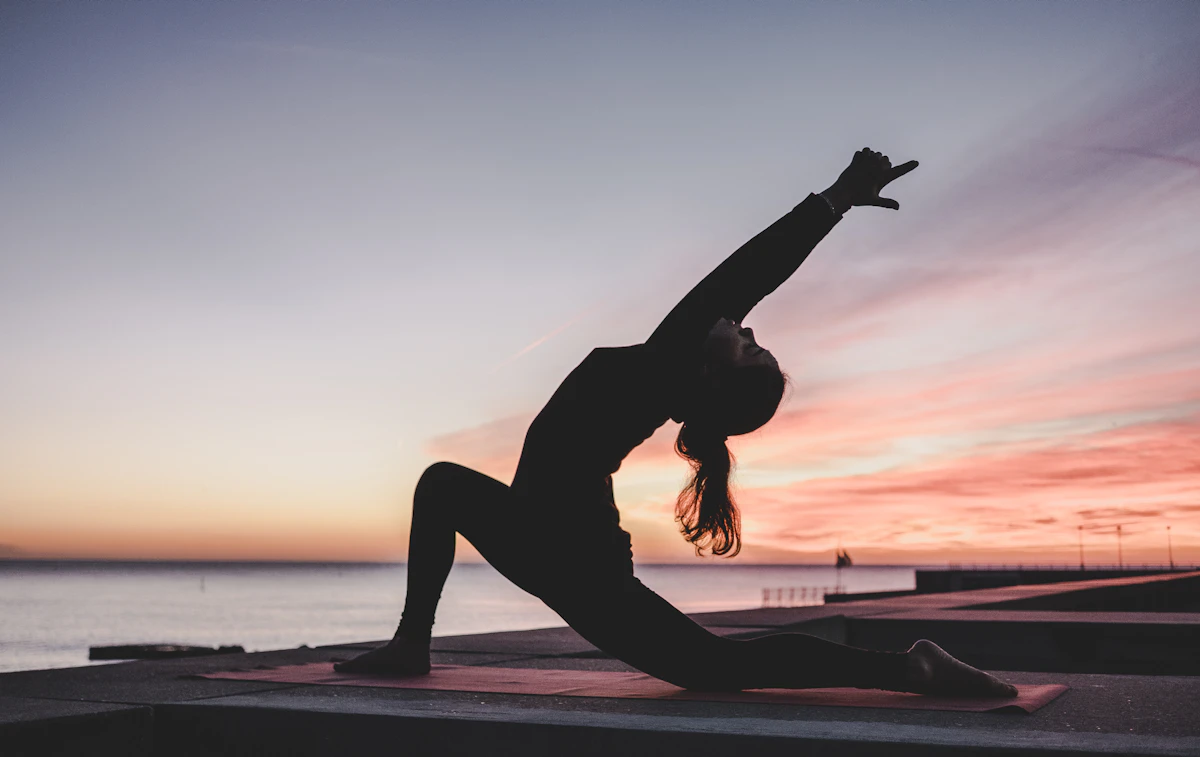
Most people think of posture as something static — a position you sit or stand in. It isn't. Posture is a habit, and like any habit, it's built by repetition. The good news: Pilates is one of the most efficient ways to build a better one.
At RFRM/OUT, we don't teach "standing tall." We teach the underlying mechanics that make standing tall the natural, effortless result. Over the last decade in the studio, we've found that five classical Pilates principles do most of the work — and none of them require you to try harder.
01 · Breath
You cannot fix your posture without first fixing your breath. This is not a metaphor. When you breathe shallowly into the upper chest — which most of us do — the muscles that hold the ribcage down never engage, and the neck takes on the work that the diaphragm was meant to do.
Pilates breathing is lateral and full. You inhale through the nose and expand the ribs out to the sides, not the belly. You exhale slowly through the mouth, and as you exhale, the deep core gently draws in. Every session we teach starts here, because every other principle builds on it.
Try This
Place your hands on your lower ribs. Inhale for four counts, feeling the ribs widen beneath your hands. Exhale for six, feeling the ribs gently draw back together. Do this five times, and notice how different your neck and shoulders feel afterward.
02 · Alignment
Alignment is not about standing up straight like a soldier. It's about stacking the skeleton in a way that lets the muscles relax around it. In Pilates we look for neutral spine — the natural curves of the back in balance, not flattened and not exaggerated.
Alignment is what separates posture you have to hold from posture that holds you. When your bones are stacked well, your muscles only need to do what they're designed to do — nothing more. This is why clients often leave their first session feeling like their shoulders have dropped two inches.

03 · Centre
In Pilates, "the centre" refers to the deep muscles that wrap around your spine — the transverse abdominis, the multifidus, and the pelvic floor. These aren't the muscles you see. They're the ones that hold you up from the inside.
When your centre is engaged, standing up straight becomes almost effortless because your spine is being supported from the inside out. This is the principle most new clients struggle with at first — because the sensation of a working deep core is genuinely new for most people.
"Posture is not something you do at your desk. It's something your body returns to when you stop thinking about it — and that's what we're building."
04 · Control
Every Pilates movement happens with intention. There are no swinging limbs, no bouncing, no momentum doing the work. This is why the practice is often described as "slow, but harder than it looks."
Control is what makes the practice transferable. A person who has learned to move with control in the studio will move with control at their desk, on the stairs, and lifting a suitcase overhead. Posture, in this view, is simply control applied to the way you hold yourself through the day.
In Practice
Try moving at half speed for one full week.
When you stand up from a chair, sit down, or pick something off the floor, slow the movement down. Let your core do the work instead of your momentum. Clients are consistently surprised at how much their posture improves just from this one habit.
05 · Flow
The last principle is the most underrated. Pilates is not a series of isolated exercises. Each movement flows into the next, with breath as the connective tissue. When you move in flow, your body learns to move in flow — and posture becomes a natural expression of that rather than a separate thing you have to remember to do.
Flow is also what makes Pilates sustainable. It's the reason our members can practice for years without it ever feeling like a chore. The practice becomes something your body looks forward to, not something it endures.

Bringing it home
You don't need a reformer to start improving your posture. You need attention and consistency. If you take nothing else from this article, take this: the practice is small, but the practice is daily. Five minutes of conscious breathing and moving at half speed, every day, will do more for your posture than one hour of intense effort once a week.
And if you'd like a coach to guide you through it — to point out what your body has been doing without you noticing — we'd love to see you in the studio.

Written By
Elena Voss
Founder and Lead Instructor at RFRM/OUT Pilates Studio. Classically trained in London, Elena has spent over a decade teaching precision-led Pilates in the North West.
Read Full Bio →