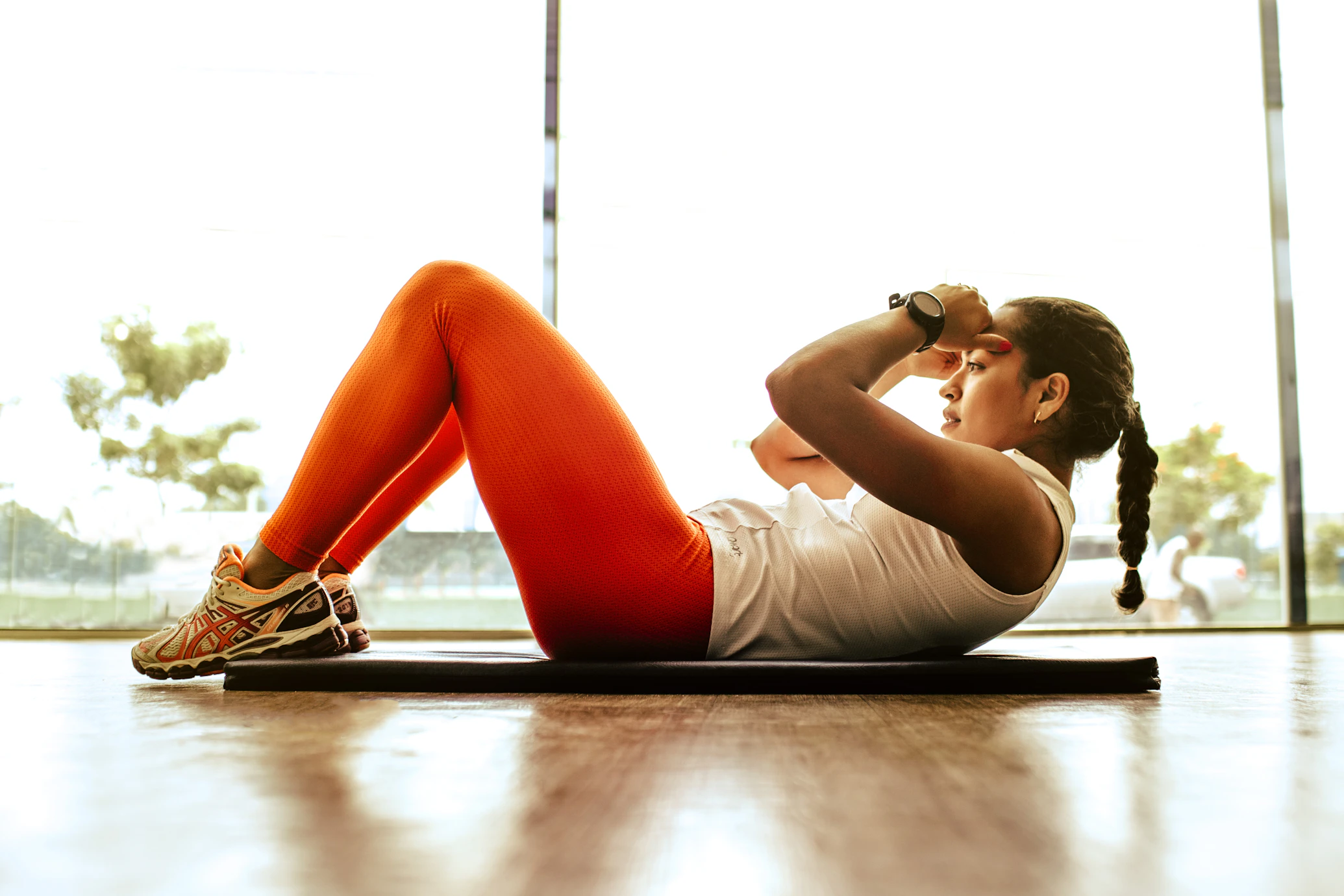
The Core
Everything begins at the centre.
The core is not just your abs. It is a 360-degree system of muscles that wraps your spine — and it's the foundation of every movement you make.
The Core
The core is not just your abs. It is a 360-degree system of muscles that wraps your spine — and it's the foundation of every movement you make.
Redefining The Core
When most people hear "core," they picture a six-pack. That's the outermost layer — and honestly, the least important. The core that actually holds you up is deeper, quieter, and rarely visible.
Think of your core as a cylinder. The front is your transverse abdominis. The back is your multifidus. The sides are your obliques and quadratus lumborum. The top is your diaphragm. The bottom is your pelvic floor. Together, they create the pressure system that stabilises your spine before every movement of your arms and legs.
When that system works well, you move with control, ease, and confidence. When it doesn't, the load shifts to your back, hips, and knees — and that's where pain begins. This is why we train the core the way we do.
Anatomy
Hover over each point on the diagram to see which muscles make up your deep core system — and what each one actually does.

01 · DIAPHRAGM
Your primary breathing muscle. When it works in coordination with the pelvic floor, it creates the pressure that stabilises your spine during movement. Most people breathe in a way that bypasses it entirely.
02 · TRANSVERSE ABDOMINIS
The deepest abdominal layer, wrapping around your waist like a corset. It doesn't bend you forward — it flattens and supports. It's the first muscle to fire before you lift, step, or reach.
03 · MULTIFIDUS
A series of small muscles that run along your spine, providing segment-by-segment support. When these weaken (as they often do after injury or prolonged sitting), the spine loses its natural protection.
04 · PELVIC FLOOR
The bowl of muscles at the base of your pelvis. It supports your organs, contributes to continence and sexual function, and works hand-in-hand with the diaphragm on every breath you take.
Why It Matters
A weak core is not just an aesthetic problem — it's a structural one. Here's what shows up in the clinic and in the studio.
80%
Of adults experience back pain at some point in their lives
2×
Risk of injury increases with poor core stability
6h+
Average daily sitting time that deactivates the deep core
3mo
Consistent training to rebuild functional core strength
How We Train It
Every core exercise we teach is built on these principles. They're what separate Pilates from a generic ab workout.
Before any movement, we set the breath. Inhaling through the nose, expanding the ribcage laterally, then exhaling to engage the deep core. The breath is the switch that turns the core on — not crunches, not planks.
We train the transverse abdominis and pelvic floor before we ever think about the "six-pack" muscles. The superficial layer is strong and fast — but it can't protect your spine if the deep layer isn't doing its job.
You can't build meaningful strength on an unstable foundation. We spend time making sure the spine is safe and supported before adding load, speed, or complexity.
Your core doesn't work in isolation — it coordinates with your hips, shoulders, and breath. We train it that way, so what you build in the studio translates into how you actually move.
Eight precise repetitions with full control will build more strength than twenty rushed ones. We slow things down on purpose — because that's where the real work happens.
The core responds to consistent, progressive challenge. We build difficulty gradually — and we respect that real strength takes months, not days. There's no shortcut worth taking.

The RFRM/OUT Approach
"We don't train the core for aesthetics. We train it so that your body works as it was designed — quietly, powerfully, for the rest of your life."
Elena Voss · Founder
Signature Work
A handful of the foundational core exercises you'll encounter in your first few months at RFRM/OUT.

Warm-up
The classical Pilates warm-up. Hundred pumps of the arms, five counts in, five counts out, with the core fully engaged and the ribcage set.
Foundation
Five classical abdominal exercises performed in sequence. The gold standard for building deep, functional core strength.

Stability
Not just a hold — a moving sequence. Front, side, and dynamic variations that challenge the core in every direction.

Control
A single slow articulation of the spine from lying to sitting. Sounds simple. Reveals everything about how your core and back work together.

Mobility
Small circles, huge challenge. Trains the core to stabilise the pelvis while the legs move — a skill that carries into every step you take.

Reformer
The reformer's moving carriage adds resistance and instability — challenging the core in ways mat work alone can't replicate.
Your Journey
MONTH 1
You learn what it actually feels like to engage your deep core. Most people are surprised — and humbled. This month is about the connection, not the effort.
MONTH 2–3
The engagement becomes automatic in class. Movements get slower, more precise, more intentional. You start noticing your posture in everyday life.
MONTH 3–6
Real, functional strength shows up. Exercises that felt impossible in month one become the warm-up. Your back and hips start to feel lighter.
MONTH 6+
The core becomes a background process. You move better without thinking about it. This is where the practice stops being exercise and becomes part of who you are.
Who It Helps
Whatever your body is doing — sitting, running, lifting, or healing — the core is working. Training it well improves everything else.
✦
The majority of chronic back pain is related to poor core support. Rebuilding it is often the missing piece.
✦
A strong core means less energy leaked, more power transferred, fewer injuries picked up along the way.
✦
Pregnancy changes the core system dramatically. Sensitive, targeted rebuilding is essential to long-term function.
✦
Core strength is one of the strongest predictors of independence and injury risk as we age. It's never too late to build it.
Start Strong
Book your first session and start training your core the way it deserves to be trained.